
Provider defines the cohort
Set inclusion and exclusion criteria, consent route, episode length, photograph schedule and clinical ownership.
For NHS and care providers
Healing Process is designed to help services receive more comparable photographs, understand patient-reported change and manage review activity in one auditable workflow. It is supplementary technology: the provider remains responsible for the clinical service, staffing, governance and decisions.
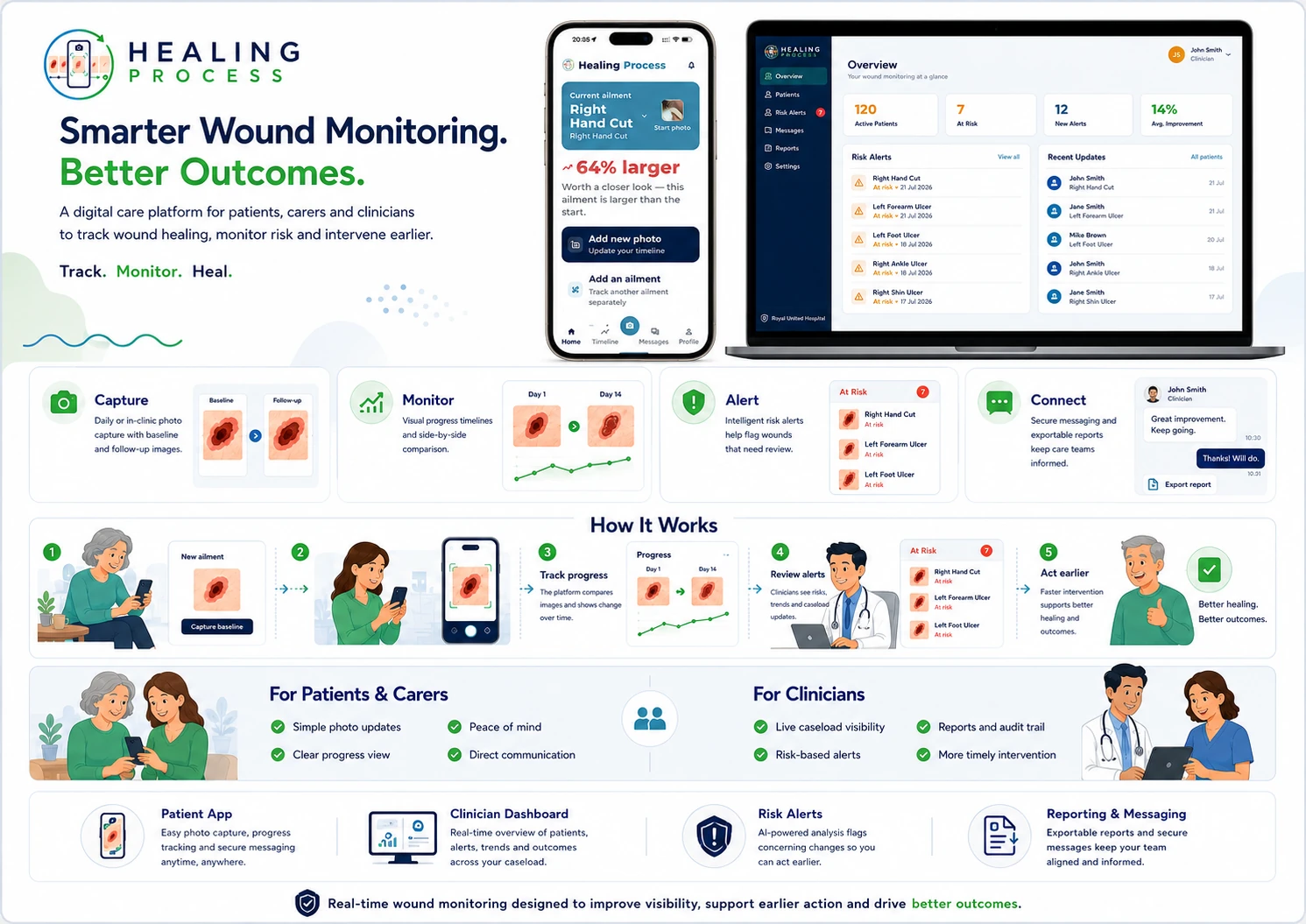
What changes operationally
The product should be configured around the provider’s existing service model—not presented as a stand-alone inbox.
Set inclusion and exclusion criteria, consent route, episode length, photograph schedule and clinical ownership.
Baseline guides and quality controls reduce avoidable variation while retaining the unaltered source image.
Submission status, image-quality limitations and apparent-change signals are kept separate from clinical urgency.
Authorised staff see identifiers, originals, notes, history, communication and local protocol information.
Advice, appointment, assessment, escalation or planned review receives a named owner and time.
Audit timeliness, failed contacts, escalation, equity, usability, safety incidents and clinical outcomes.
Dashboard experience
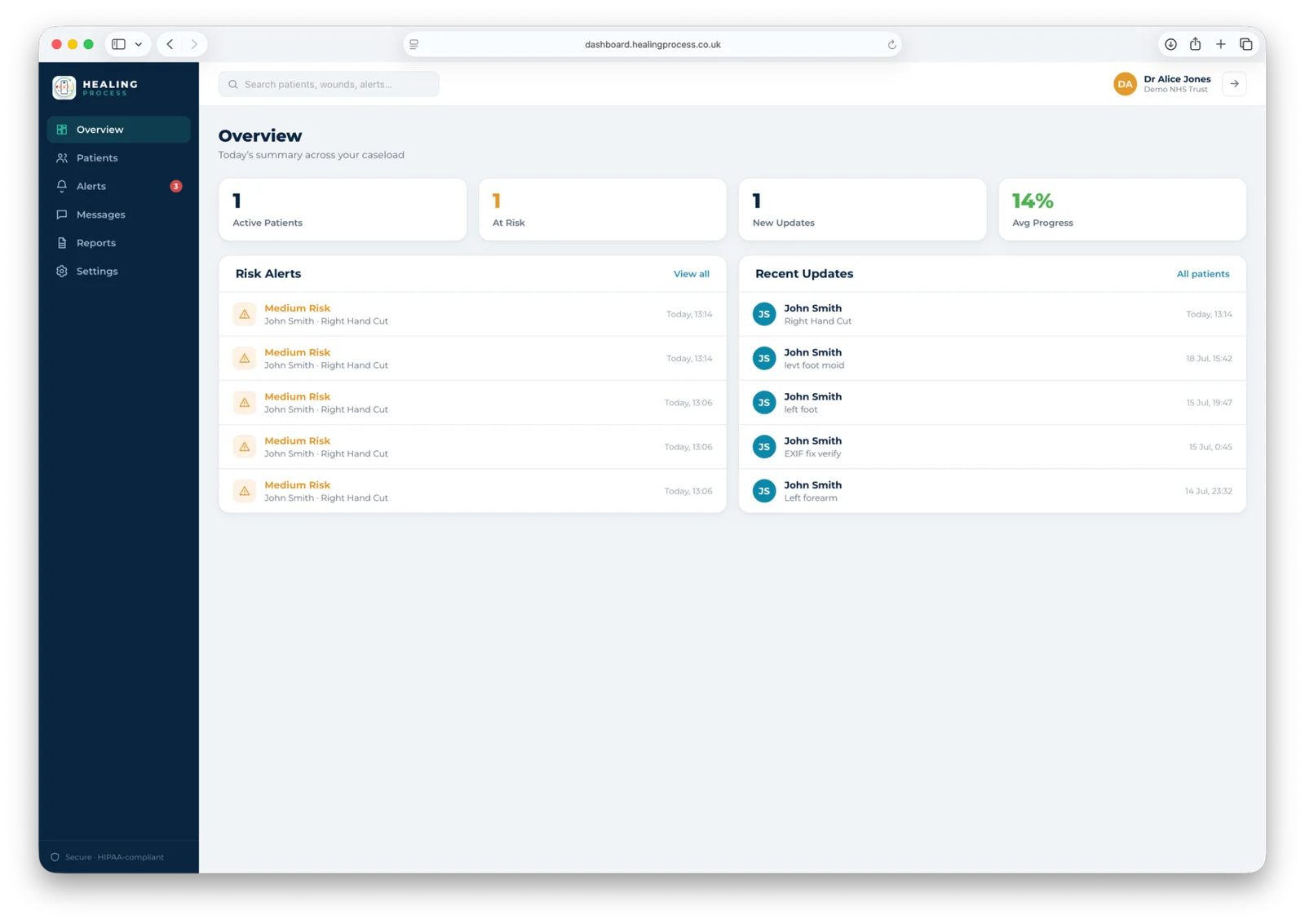
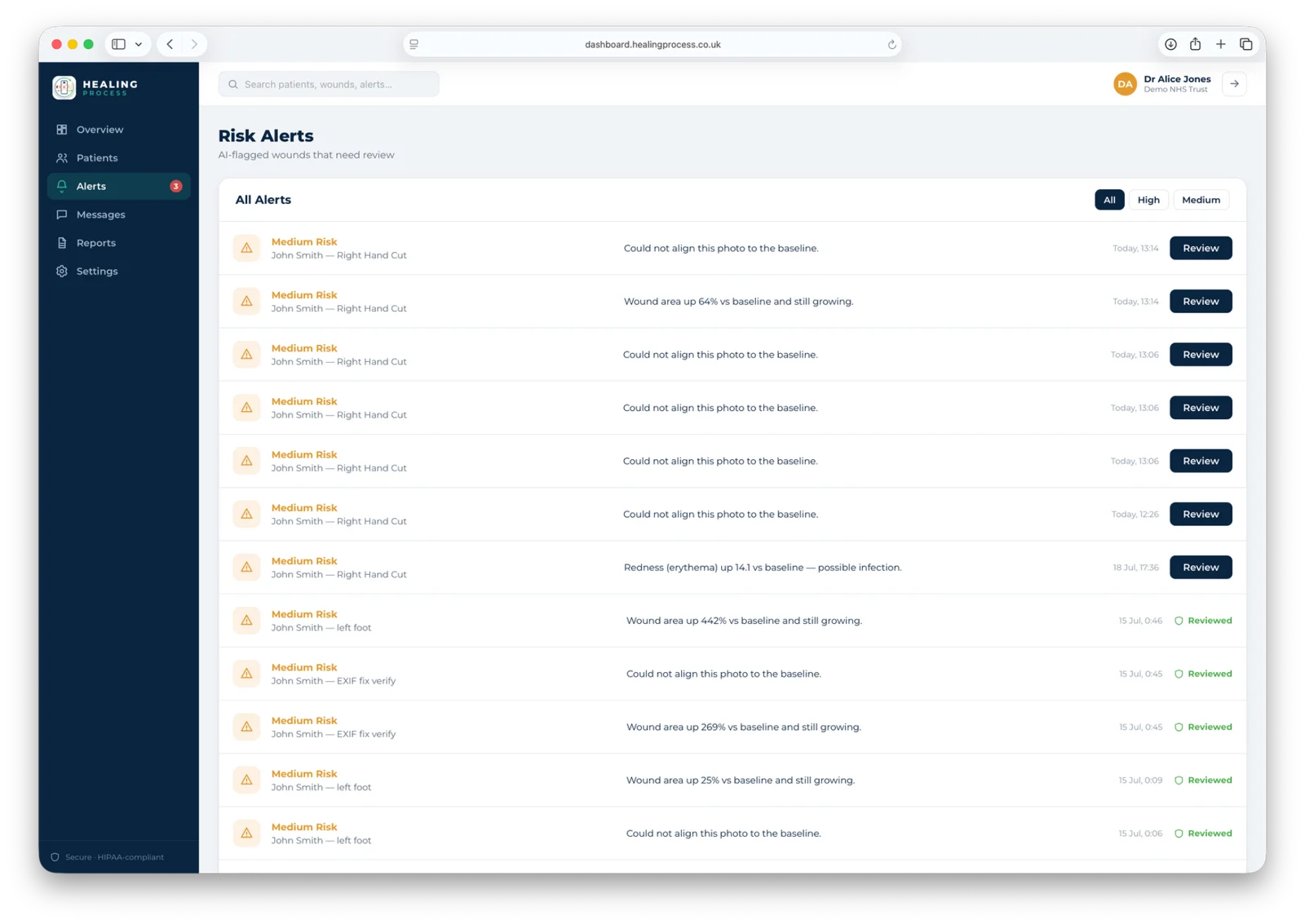
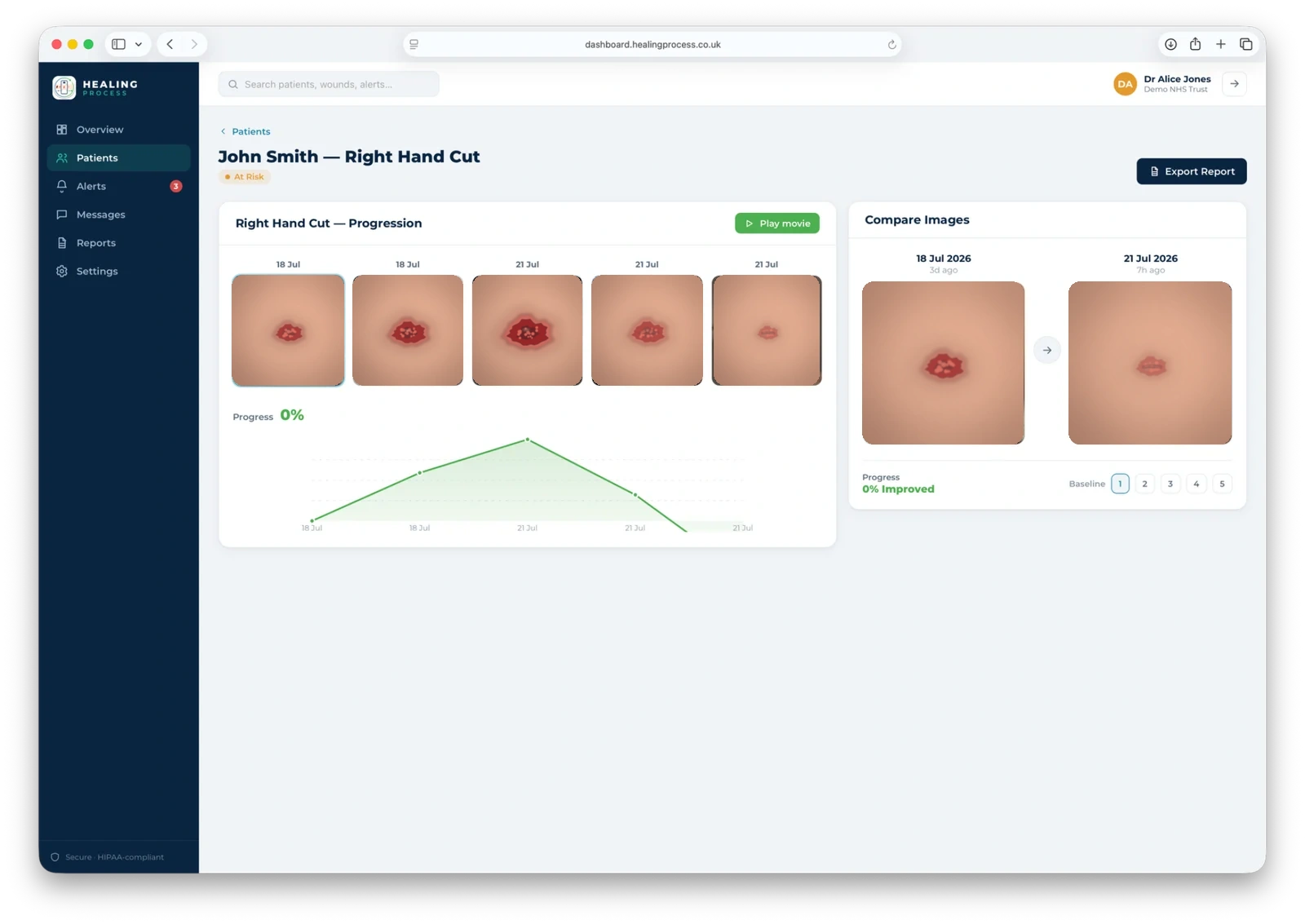
All smaller portal images below are selectable. The full-screen viewer displays the original high-resolution asset with zoom, reset and close controls.
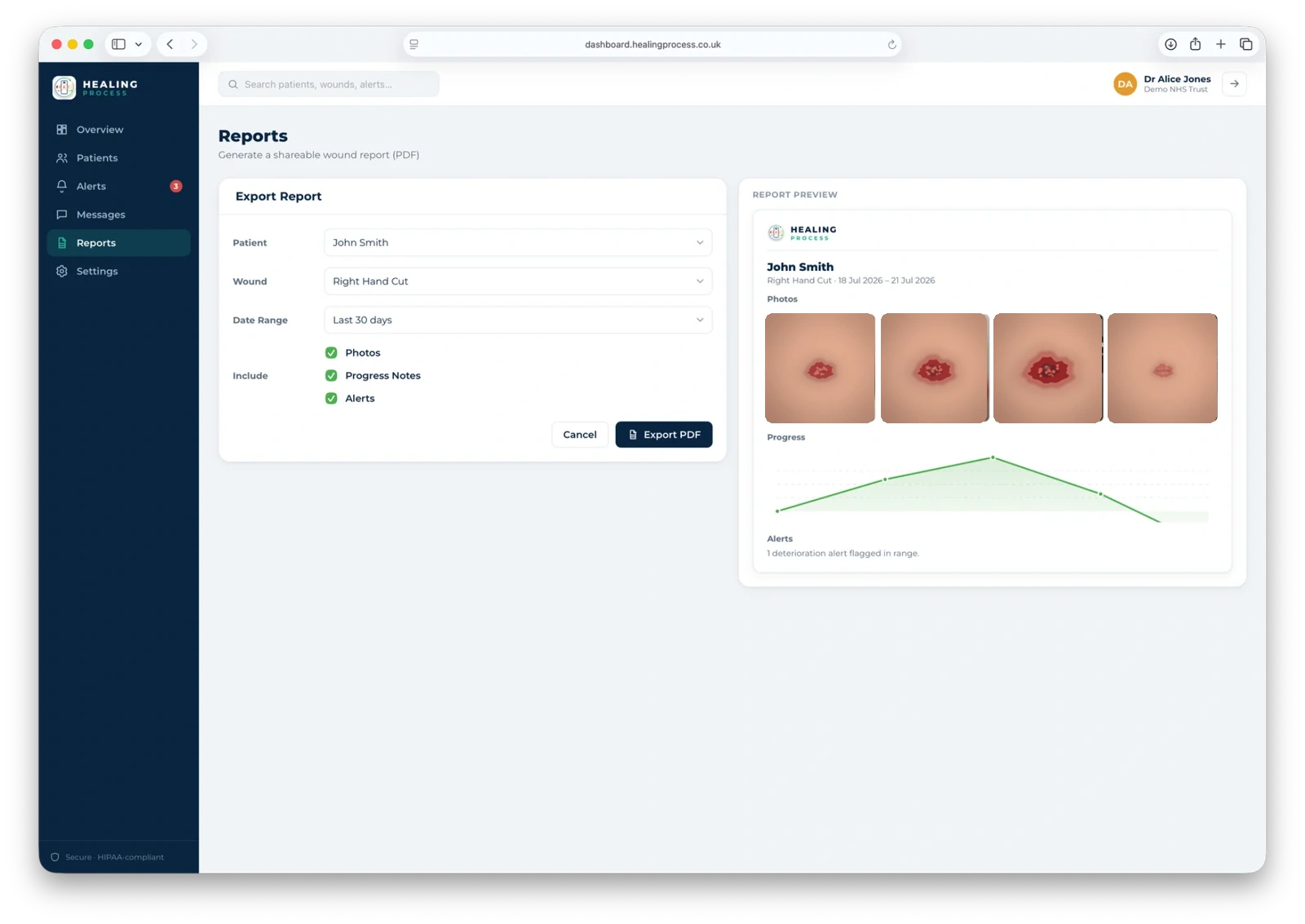
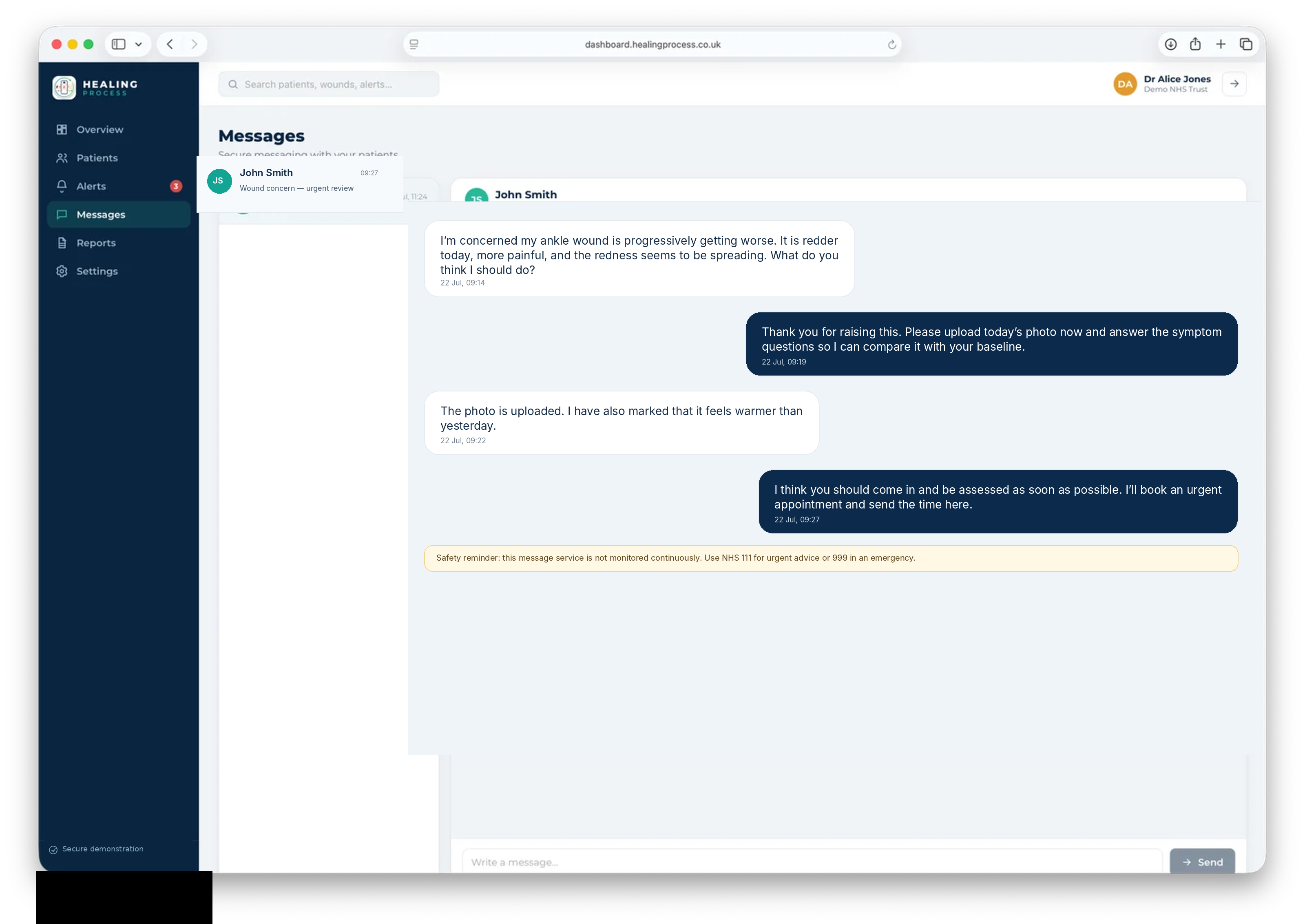
Service modes
The individual may use photographs and notes to support their own recollection and choose to share an export. The website and app must not imply that an NHS team sees or acts on entries.
Required label: “Private record—no care team is monitoring this account.”
The provider defines users, authorised roles, operating hours, response expectation, escalation and record integration.
Required label: “Linked to [service]. Reviewed [hours]. For urgent help use [route].”
Assurance workstreams
| Workstream | Examples of evidence | Provider decision |
|---|---|---|
| Clinical safety | Clinical safety officer, intended-use statement, hazard log, clinical safety case, change control, incident process and deployment safety case responsibilities. | Whether risks and local controls are acceptable for the pathway. |
| Medical-device status | Documented intended purpose, functionality assessment, regulatory advice, classification rationale, quality management and post-market plan where applicable. | Whether the product may lawfully be placed on the market and used for the proposed purpose. |
| Data protection | Controller/processor mapping, Article 6 and Article 9 conditions, DPIA, privacy information, contracts, retention, subject rights and international-transfer assessment. | Whether processing is lawful, necessary and proportionate. |
| Security | Architecture, encryption, identity and access, tenant separation, logging, vulnerability management, penetration test, incident response, backup and recovery. | Whether residual cyber and information risks are acceptable. |
| Interoperability | Identifiers, coding, APIs, structured outputs, record-writeback, messaging, error handling and data portability. | How the service fits the authoritative record and clinical workflow. |
| Usability and accessibility | WCAG testing, assistive-technology testing, accessible-information workflow, language/interpreter routes, user research and reasonable-adjustment support. | Whether the service can be used equitably by the intended population. |
Implementation decisions
Evaluation
A controlled pilot should measure image comparability, review timeliness, escalation, appointments, safety events, patient confidence, staff workload, inclusion and unintended consequences against a documented baseline.
Missed deterioration, false reassurance, delayed review, wrong-patient and failed-message events.
Image acceptance, repeated capture, review completion and record completeness.
Patient, carer and staff usability, accessibility and communication confidence.
Travel avoided, appointments changed, staff time, service capacity and cost consequences.
The supplied checklist turns product, clinical, data, equality, security and operating questions into named evidence and approval gates.